










Quantum Advisors Private Limited (QAPL) is incorporated in India and is registered with the Securities and Exchange Board of India (SEBI) as Portfolio Manager vide registration number INP000000187.
India is seen as a growth allocation; Is it now also a diversifier to global equity risk
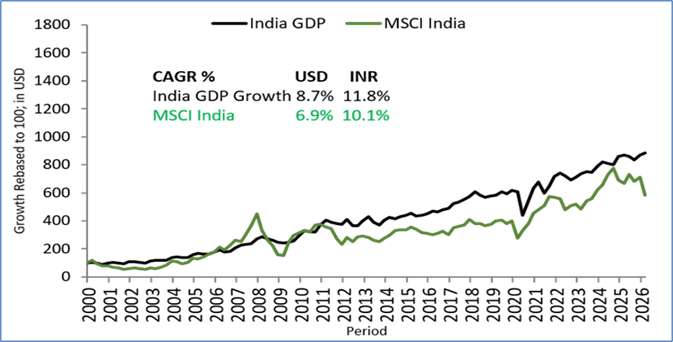
The India investing story is a simple story of consistent long-term real and nominal GDP growth, which is converted into revenues and profitability by firms, and which is reflected and rewarded by long-term returns in the stock market.
This is why we also term it ‘Predictable India’ – a close link between long-term GDP growth and stock market returns.
Chart 1:The ‘Predictable’ Link between GDP growth and stock market returns
Source: Bloomberg & MSCI, all data in USD, GDP and Index data is quarterly till March 2026. This is only for representation and understanding purpose and does not assure any promise or guarantee of same in the future. Past performance does not guarantee and is not indicative of future results
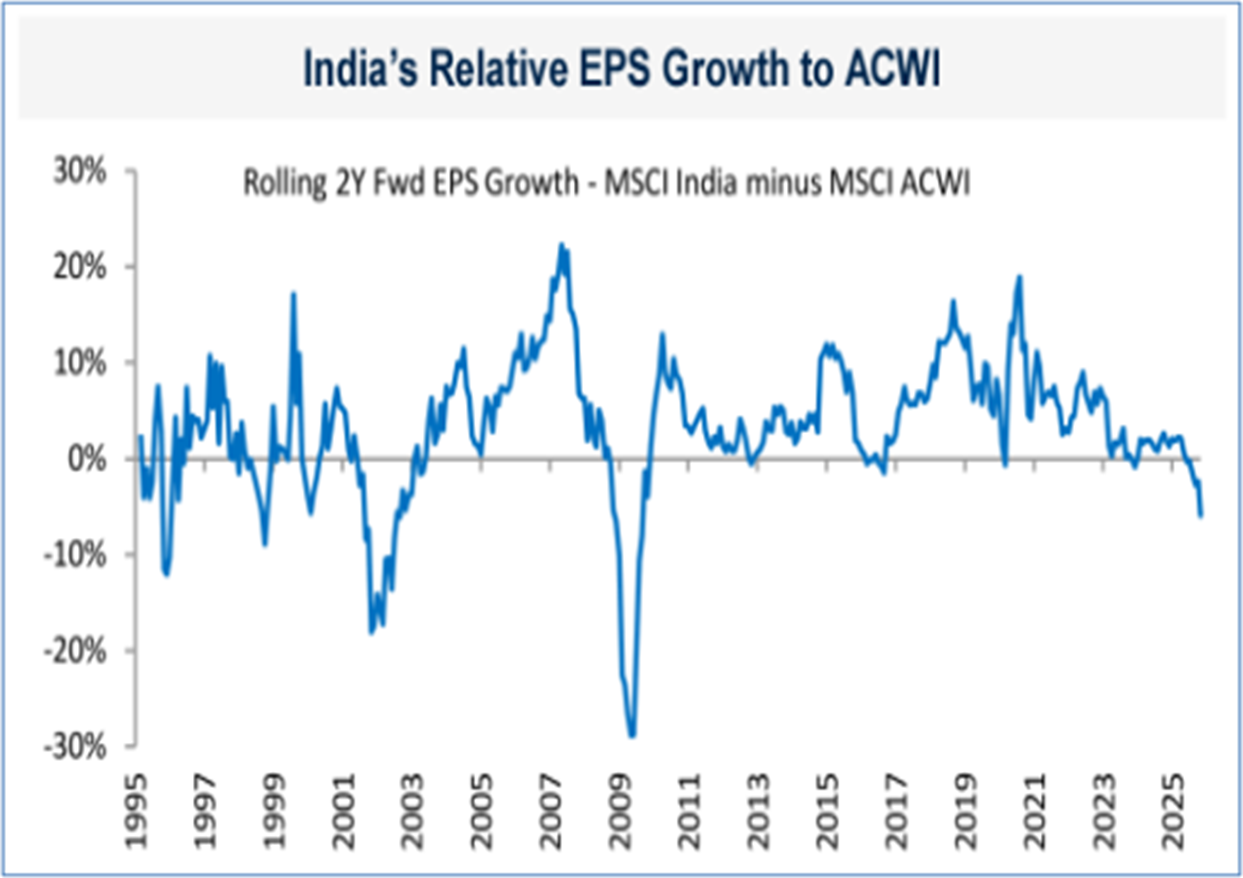
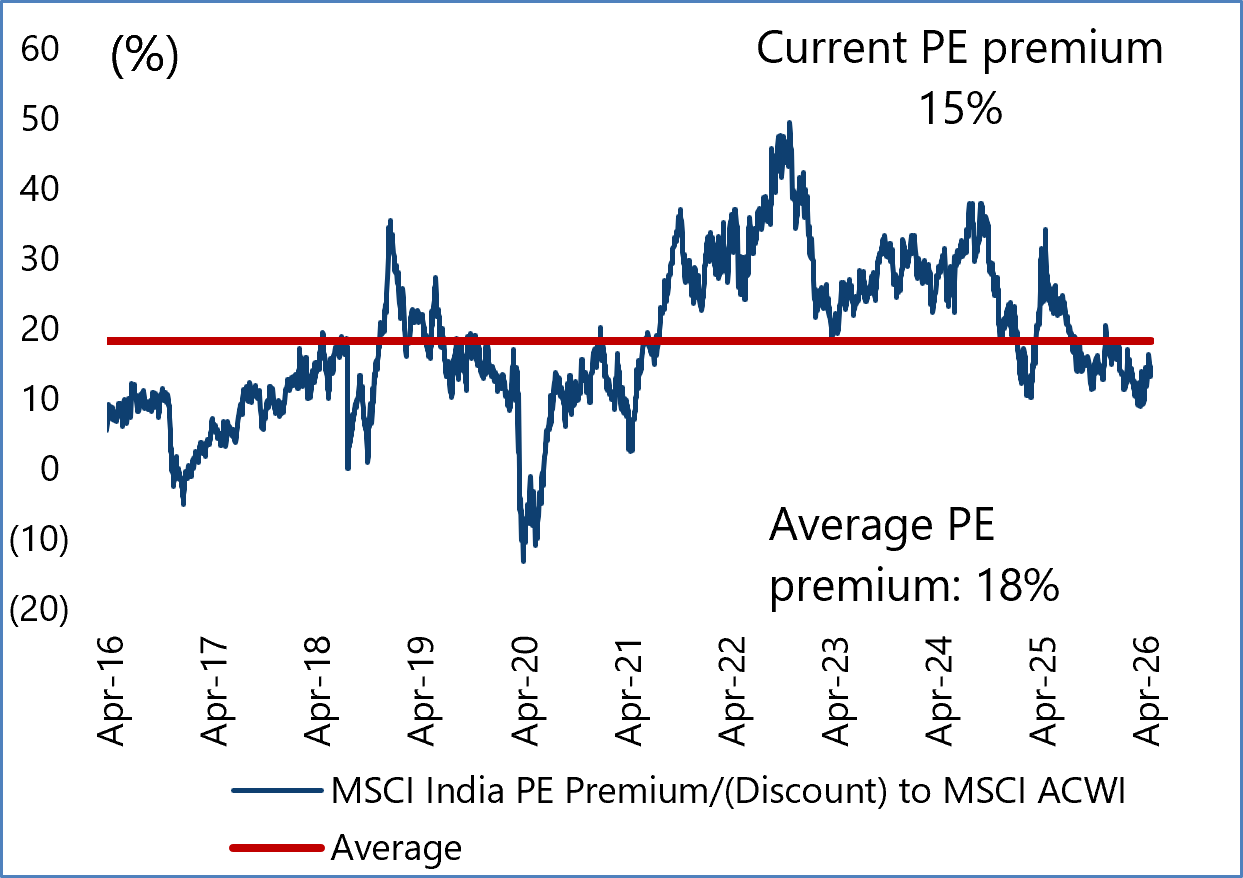
Indian GDP growth, company profitability and corporate return ratios over long cycles have tended to be higher than other markets/indices, and hence India also tends to trade at a valuation premium over other world markets.
Chart 2 and Chart 3:India commands a valuation premium due to higher growth potential
Source: Chart 2 – Morgan Stanley Research, India Strategy Playbook, August 2026;
Source: Chart 3 – Jefferies Research, August 2026
ACWI – All Country World Index; EPS – Earnings Per Share; PE – Price to Earnings This is only for representation and understanding purpose and does not assure any promise or guarantee of same in the future. Past performance does not guarantee and is not indicative of future results
However, as visible in all charts, India’s recent market performance has been underwhelming. Indian markets absolute and relative earnings growth has been lower/weaker than historical averages and thus has seen a price and valuation correction.
Table 1:India’s record underperformance – Has it reversed?
| (Gross Total Returns in USD) | 1 Month | YTD | Sept 2024 to July 2026 |
|---|---|---|---|
| MSCI India Index | 1.8% | -8.1% | -12.5% |
| MSCI Korea Index | -17.1% | 81.5% | 185.9% |
| MSCI Taiwan Index | -5.3% | 54.0% | 126.1% |
| MSCI Emerging Markets Index | -3.0% | 20.3% | 58.9% |
Source:Bloomberg, MSCI, as of July 31, 2026. Indian markets peaked in September 2024 and hence we have used that as a representative period to show cumulative performance since then. Past performance may or may not sustain in the future. Returns may increase or decrease as a result of currency fluctuations. Please refer to the Disclosure Statement at the end of this document.
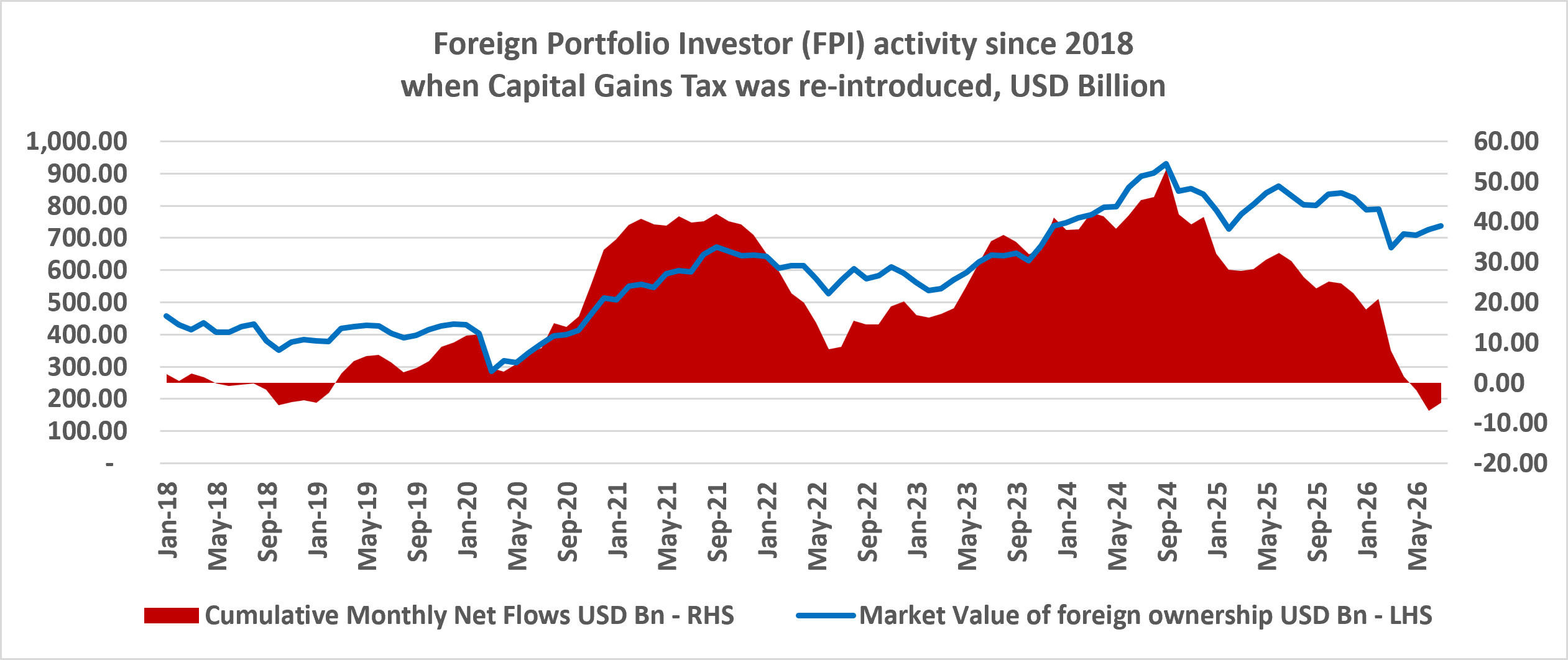
This was not unexpected. Our 2026 outlook was titled Simple Story, Getting Complicated – where we reviewed 2025 with how growth impulses were slowing; valuations had remained stretched and market returns were to be modest. The extent of foreign investor selling and the dramatic underperformance though has also meant that India’s weightage in global indices has fallen sharply.
Chart 4:Are Foreign Investors ‘anti- India’?
(Source: NSDL FPI Monitor, Data till July 2026) Past performance may or may not sustain in the future. Returns may increase or decrease as a result of currency fluctuations. Please refer to the Disclosure Statement at the end of this document.
Chart 5:India’s has seen a dramatic fall in allocation in global/emerging market portfolio
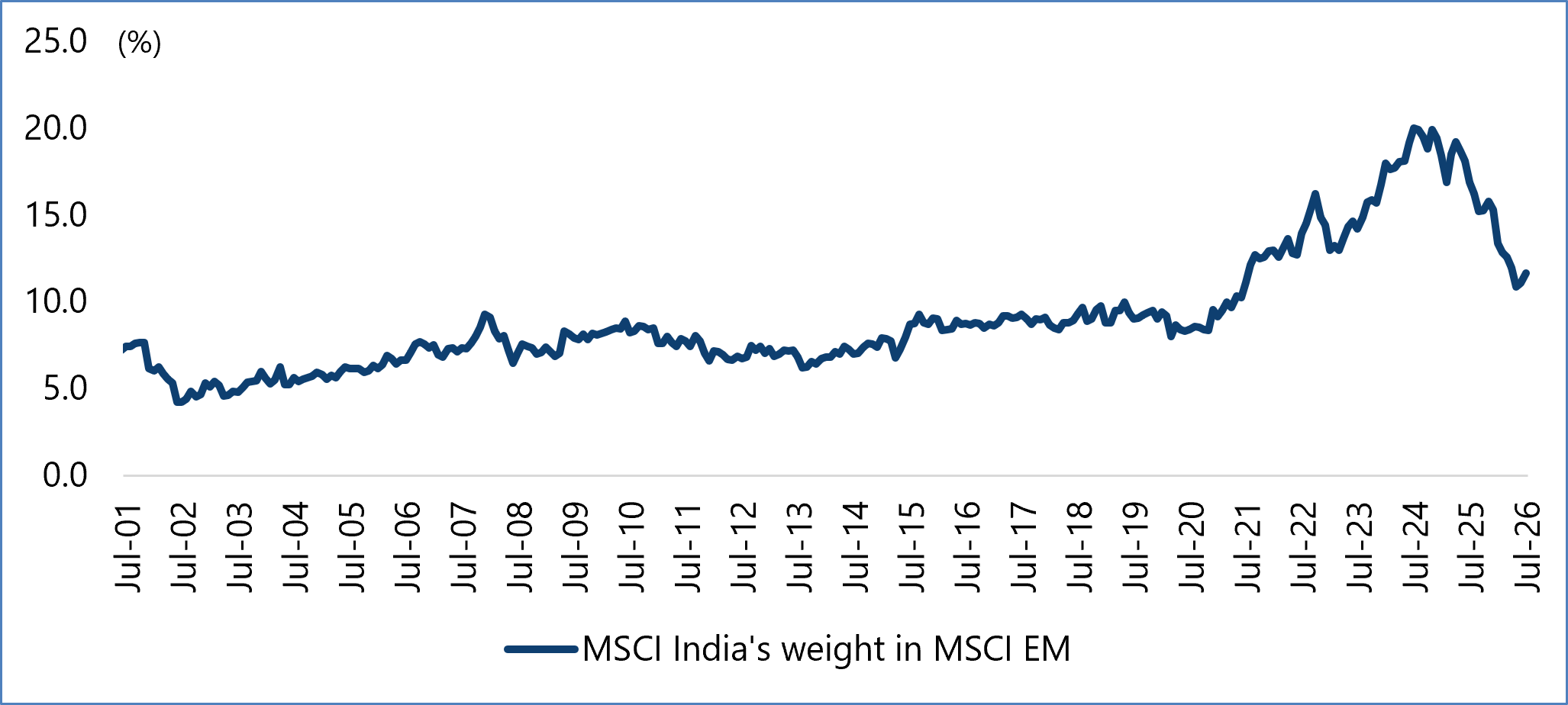
(Source:Jefferies Research, Data as of July 2026) EM = Emerging market Index; Past performance may or may not sustain in the future. Returns may increase or decrease as a result of currency fluctuations. Please refer to the Disclosure Statement at the end of this document.
As seen in the charts above, Foreign investors have sold over USD 50 billion since September 2024. India’s weight in the MSCI emerging markets index is now down by almost half to ~11% from the peak of ~20%. Global emerging market managers also seem to be running an India under-weight in their portfolios.1
As we spoke in our webinar – India Investing: ‘TINA’ to ‘ANTI’, India investment sentiment has changed dramatically, especially post the advent of the AI investing thematic. With India markets lacking exposure to AI thematic in terms of clear plays on – AI foundational labs, memory companies, semi-conductor chip manufacturers, data centers etc., India has seen outflows from global investors and at the same time it has underperformed the likes of Taiwan, Korea, and broad emerging markets. 2 (see Table 1)
As the AI thematic seems to be facing a few hiccups, we have seen India’s relative performance improve over the past 2 months. If India underperformed for being ‘Not AI’; should India outperform when the world turns ‘Anti AI’.
The overall exposure to this AI thematic in an investment portfolio is likely to be reasonably high. Apart from tech and related stocks in public markets, global institutional investors will also have increased exposure through their private equity investments, holders of bonds issued by hyper scalers, data center’s and the ecosystem in their infrastructure and real estate allocations. Also, these assets would also show increased correlations. We believe there is substantial risk sitting in global portfolios exposed to this AI thematic. This risk will need to be diversified.3
Chart 6:AI concentration risk in global equity allocations is rising. India is diversified
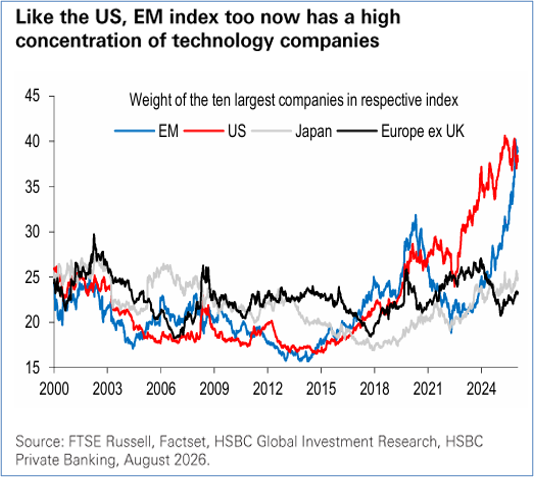
(Source: HSBC Investment Research, CIO Academy)
| Sector | MSCI AC World July 2026 |
MSCI India July 2026 |
|---|---|---|
| Information Technology | 30% | 7% |
| Financials | 17% | 31% |
| Industrials | 11% | 11% |
| Consumer Discretionary | 9% | 13% |
| Healthcare | 8% | 6% |
| Communication Services | 8% | 5% |
| Consumer Staples | 5% | 5% |
| Materials | 4% | 9% |
| Energy | 4% | 8% |
| Utilities | 2% | 4% |
| Real Estate | 2% | 1% |
(Source: MSCI, Quantum Advisors)
India as Risk Diversifier
This is unusual given the usual logic of allocating to India given the long-term consistent growth in the economy and its reflection in stock market returns.
However, given the trend of thematic AI allocation which has no doubt done well and the fact that India does not have any relevant play and has thus underperformed, has led to a dramatic reduction in India’s allocation in global portfolios. We have argued in the past on the Great India Under-allocation.
The recent trend has exacerbated India’s under allocation. We will make the case that global AI thematic exposure is a lot higher given the exposure across asset class and the cross correlation. An increased allocation to India at this juncture should ideally be considered as a hedge against the global AI trade.
Chart 7:India Investing across Global Mood Swings
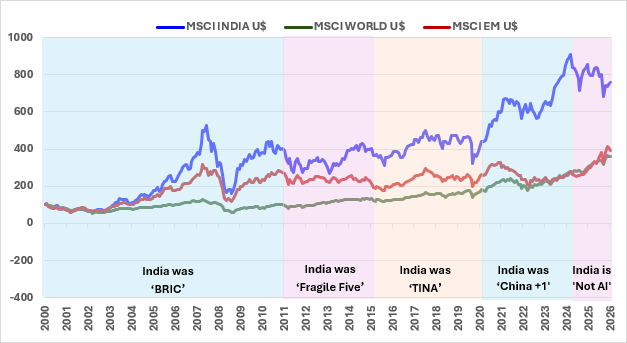
(Source: Refinitiv, MSCI, in USD, rebased to 100 in July 2000, EM = Emerging Markets, Data till July 2026) Past performance may or may not sustain in the future. Returns may increase or decrease as a result of currency fluctuations. Please refer to the Disclosure Statement at the end of this document.
Sources and Footnotes:
1 Jefferies Research – India Strategy
2 India is NOT AI – HSBC Global Research
3 AI exposure risk and total portfolio – MSCI
Important Disclosures & Disclaimers
Quantum Advisors Private Limited (QAPL) is registered in India and holds a Portfolio Management License from Securities and Exchange Board of India (SEBI), India vide registration number INP000000187. It is also registered with the Securities Exchange Commission, USA as an Investment Adviser and a Restricted Portfolio Manager with the Canadian Provinces of British Columbia (BCSC), Ontario (OSC), and Quebec (AMF). It is not registered with any other regulator. (Note- Registration with the above regulators does not imply any level of skill or training).
Investments in markets is subject to Market Risk. There is no guarantee or assurance that the historical results are indicative of future results.
The views expressed herein shall constitute only the opinions and any information contained in this material shall not be deemed to constitute an advice or an offer to sell/purchase or as an invitation or solicitation to invest in any security and further Quantum Advisors Private Limited (QAPL) and its employees/directors shall not be liable for any direct or indirect loss, damage, liability whatsoever arising from the use of this information.
Information sourced from third parties cannot be guaranteed or was not independently verified. Whilst no action has been solicited based upon the information provided herein, due care has been taken to ensure that the facts are accurate, and the views given are fair and reasonable as on date. All the forward-looking statements made in this communication are inherently uncertain and we cannot assure the reader that the results or developments anticipated will be realized or even if realized, will have the expected consequences to or effects on, us or our business prospects, financial condition or results of operations.
Readers are cautioned not to place undue reliance on these forward-looking statements in making any investment decision. Forward-looking statements made in this communication apply only as of the date of this communication. While we may elect to update forward-looking statements from time to time, we specifically disclaim any obligation to do so, even if internal estimates change, unless otherwise required by applicable Securities laws.
This article is for educational and discussion purposes only and is not intended as an offer or solicitation for the purchase or sale of any investment in any jurisdiction. No advice is being offered nor recommendation given.
Recipients should exercise due care and caution and if necessary, obtain the professional advice prior to taking any decision based on this information.
The "Index" is a product of Asia Index Private Limited (AIPL), which is a wholly owned subsidiary BSE has been licensed for use by QAPL. BSE® is a registered trademark of BSE Limited (“BSE”), and these trademarks have been licensed for use by AIPL and sublicensed for certain purpose by QAPL. All rights reserved. Redistribution, reproduction and/or photocopying in whole or in part are prohibited without written permission of AIPL. For more information on any of AIPL’s indices please visit http://www.asiaindex.com/. None of AIPL, BSE, their affiliates nor their third party licensors make any representation or warranty, express or implied, as to the ability of any index to accurately represent the asset class or market sector that it purports to represent and none of AIPL, BSE or their affiliates nor their third party licensors shall have any liability for any errors, omissions, or interruptions of any index or the data included therein.
Certain information contained herein (the “Information”) is sourced from/copyright of MSCI Inc., MSCI ESG Research LLC, or their affiliates (“MSCI”), or information providers (together the “MSCI Parties”) and may have been used to calculate scores, signals, or other indicators. The Information is for internal use only and may not be reproduced or disseminated in whole or part without prior written permission. The Information may not be used for, nor does it constitute, an offer to buy or sell, or a promotion or recommendation of, any security, financial instrument or product, trading strategy, or index, nor should it be taken as an indication or guarantee of any future performance. Some funds may be based on or linked to MSCI indexes, and MSCI may be compensated based on the fund’s assets under management or other measures. MSCI has established an information barrier between index research and certain Information. None of the Information in and of itself can be used to determine which securities to buy or sell or when to buy or sell them. The Information is provided “as is” and the user assumes the entire risk of any use it may make or permit to be made of the Information. No MSCI Party warrants or guarantees the originality, accuracy and/or completeness of the Information and each expressly disclaims all express or implied warranties. No MSCI Party shall have any liability for any errors or omissions in connection with any Information herein, or any liability for any direct, indirect, special, punitive, consequential or any other damages (including lost profits) even if notified of the possibility of such damages.
Our Strategies
Explore how our two main strategies – Predictable India Equity and India Integrity Equity - with demonstrated success of our tried and tested research and investment processes can ensure your India equity allocation will have higher predictable outcomes and no surprises.
Q India Value Equity Strategy
20+ years of India Long-only, Liquid, High-Governance, Margin of safety = Predictability
Integrity screen since 1996, strategy Track record since 2000.
Q India Responsible Returns Strategy
Liquid, proprietary Integrity Scores, Financial Soundness
Integrity Screen since 1996, enhanced criterion since 2015, strategy Track Record since 2019; strategy AuM: $9.7 mn Mandate Capacity: $5 billion
Quantum Advisors pioneered a quantitative as well as qualitative analytical approach to equity investing in India, providing for the first time, consistently applied valuation metrics to evaluate investment opportunities in India’s emerging stock markets. Over the years, Quantum Advisors has continued and enhanced its tradition of extensive financial analysis and value investing, as it has evolved into an investment advisor and asset manager.
Our investment philosophy and strategy involves the use of intensive qualitative and quantitative fundamental analysis. We build and monitor our clients’ portfolios actively while at the same time avoiding excessive trading, and control risk by endeavoring to keep our clients’ portfolio adequately diversified, both in terms of the sectors included in those portfolios, as well as with respect to the level of concentration in any specific security.